
Rugby had 2,250 people claiming out-of-work benefits in October, the most since October 2021. Claimants aged 16 to 24 rose 23% in a year, to 480.
Rugby borough had 2,250 people claiming out-of-work benefits in October 2026. That is the highest count since October 2021, when it was 2,350.
It is 185 more than in October 2025, a rise of 9.0%. Young people again account for the sharpest rise. 480 claimants were aged 16 to 24, up from 390 a year earlier.
The figures come from the claimant count for October 2026, which the Office for National Statistics published through nomis on Tuesday 17 November. Local figures are official statistics in development and are rounded to the nearest five.
The borough number
- 2,250 claimants in October 2026
- 2.9% of residents aged 16 to 64, the same as September
- 3.0% for Warwickshire, 5.4% for the West Midlands and 3.9% for the United Kingdom
- 2,065 a year earlier, in October 2025
Rugby’s rate is still below the county, regional and national rates. Its count is rising faster than the country’s, though. Over the year Rugby rose by 9.0% and Warwickshire by 8.5%, from 10,700 to 11,610. The UK rose by 3.5%.
September was revised down
Last month we reported that Rugby’s September count was 2,245. That was the first estimate. The ONS has now revised it down to 2,205.
So October’s 2,250 is a rise of 45 on the month. This is the second month running that the first estimate has come down: August’s fell from 2,245 to 2,200 in the same way.
Late claims and corrections are added after each release, so the newest month is always the least certain. We have added a note to the September story.
Every October since 2020
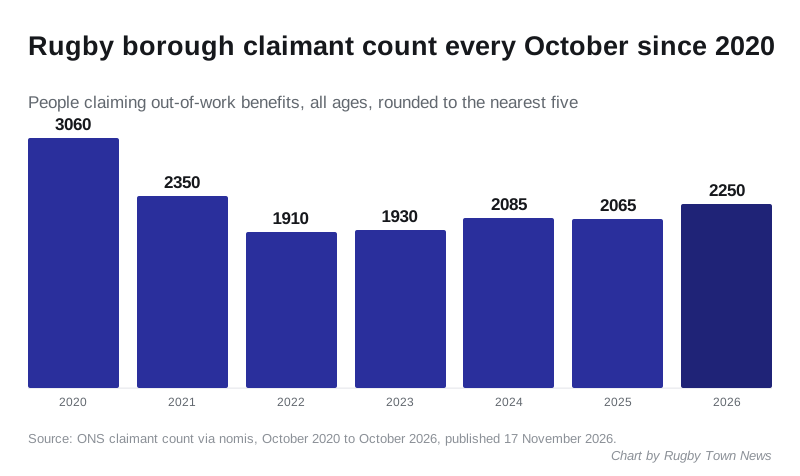
Comparing the same month each year takes out the seasonal swing. October 2020 was still in the pandemic, at 3,060. The count fell to 1,910 by October 2022. It has crept up since, and this October is the highest of the last five.
Young people: up 23% in a year
| Age | October 2025 | October 2026 | Change |
|---|---|---|---|
| 16 to 24 | 390 | 480 | +90 (+23.1%) |
| 25 to 49 | 1,185 | 1,235 | +50 (+4.2%) |
| 50 and over | 490 | 530 | +40 (+8.2%) |
The 16 to 24 count is the highest in Rugby since May 2021, when it was 515. It rose by 30 in a month, from a revised 450 in September.
Rugby’s young claimant count is rising faster than the county’s. Warwickshire’s rose by 18.3%, from 2,185 to 2,585. Across the UK it rose by 9.3%.
By sex, more of the year’s rise is among women. Women claiming rose from 950 to 1,055, an increase of 105. Men rose from 1,115 to 1,190, an increase of 75.
The data counts claims, not the reasons for them. It also includes some people on Universal Credit who are in low-paid work and are required to look for more.
Across Warwickshire
| District | September 2026 (revised) | October 2026 | Rate | October 2025 |
|---|---|---|---|---|
| Nuneaton and Bedworth | 3,655 | 3,760 | 4.3% | 3,605 |
| North Warwickshire | 1,195 | 1,250 | 3.1% | 1,070 |
| Rugby | 2,205 | 2,250 | 2.9% | 2,065 |
| Warwick | 2,415 | 2,505 | 2.6% | 2,255 |
| Stratford-on-Avon | 1,805 | 1,850 | 2.2% | 1,705 |
Every district added claimants between September and October. North Warwickshire rose fastest over the year, by 16.8%. Warwick district rose by 11.1%.
Ward by ward
Ward figures for October are on nomis this month. Benn ward has the most claimants in the borough.
| Ward | September 2026 | October 2026 |
|---|---|---|
| Benn | 395 | 405 |
| Newbold and Brownsover | 245 | 255 |
| New Bilton | 215 | 225 |
| Eastlands | 215 | 210 |
| Wolston and the Lawfords | 150 | 160 |
| Admirals and Cawston | 150 | 155 |
| Rokeby and Overslade | 135 | 145 |
| Hillmorton | 140 | 135 |
| Dunsmore | 115 | 125 |
| Coton and Boughton | 110 | 110 |
| Bilton | 85 | 80 |
| Paddox | 75 | 75 |
| Revel and Binley Woods | 60 | 60 |
| Clifton, Newton and Churchover | 50 | 50 |
| Wolvey and Shilton | 40 | 40 |
| Leam Valley | 20 | 15 |
Each ward is rounded to the nearest five on its own, so the wards add up to 2,245 rather than the borough’s 2,250. Month-on-month moves of five or ten in a ward are within that rounding and should not be read as a trend.
What it means for you
- If you have lost work or your hours have been cut, you can check what you are entitled to and apply for Universal Credit on GOV.UK.
- To talk to someone about a claim or a job search, GOV.UK lists how to contact Jobcentre Plus.
- If your income has dropped, you may qualify for a reduction in your council tax. GOV.UK explains how to apply for Council Tax Reduction.
The November claimant count is due from the ONS in December.
Have your say