
Errors and an invoice backlog erased a £3.5m surplus Rugby Borough Council had lined up for its 2027/28 budget gap. A further £1.8m pressure lands that year.
A £3.5 million surplus that Rugby Borough Council expected to carry into next year has disappeared. Corrections to its 2025/26 accounts, some for errors going back to around 2021, used up all of it.
The money had been earmarked to help close a budget gap the council expects in 2027/28. “This is now not available for use and either savings or alternative funding will need to be found,” the council’s Chief Financial Officer wrote.
The figures are in the year-end report Cabinet considered on 3 November. It is item 6 in the Cabinet agenda pack. Cabinet approved the report’s recommendations, according to the published minutes. The council has issued no press release about it.
What went wrong
An early, unpublished version of the year-end figures showed a provisional surplus of £3.517m. Further checks then found three problems.
- Invoices that had not been processed. The report says it was “delayed due to a backlog of invoices” in the council’s accounts payable team. Unprocessed invoices and other missed costs came to £1.737m. Grants and Section 106 developer money covered £990,000 of that, leaving £747,000. Some of the spending dated from 2024/25 and had never been recorded in that year.
- Bad debt was under-provided for years. The council sets money aside for debts it may never collect. A “basic error in the calculation table” meant too little was set aside, the report says, going back to around 2020/21. Correcting it cost £1.519m in 2025/26.
- Interest owed to council tenants’ account. The interest moved between the council’s main budget and its Housing Revenue Account, which pays for council homes, had been calculated wrongly. The balance of loans for two major house building schemes had been left out. The net result: £1.538m was owed to the Housing Revenue Account.
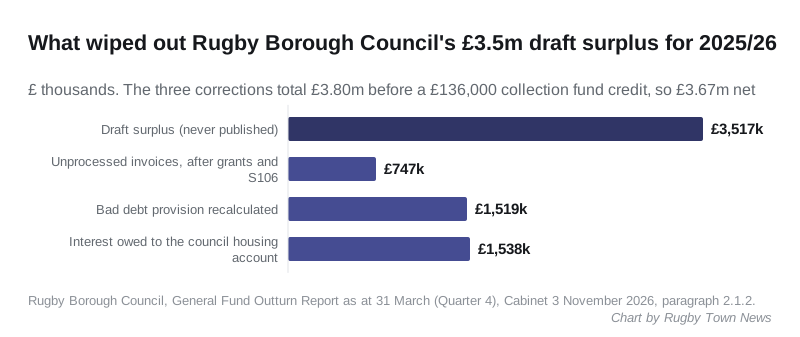
After a separate £136,000 credit on the collection fund provision, the corrections totalled £3.668m. That is slightly more than the £3.517m surplus.
The council still balanced its main budget for the year. The report records “a break-even position” against the approved budget, with a £50,000 gap met from reserves.
A second hit in 2027/28
The same bad debt error affected the council’s share of council tax and business rates debts, which sit in a separate collection fund. The report says the error seems to have started in the 2021 calculation and carried on until this year’s checks found it.
The correction will reach the council’s budget in 2027/28. The report puts it at “a one off additional financial pressure of £1.769m”.
So the 2027/28 budget loses the £3.5m it was counting on, and takes a £1.8m hit as well.
Where the money went in 2025/26
Before the corrections, services were thought to have overspent by £707,000. The final figure is £2.973m. The biggest cost pressure was agency staff:
| What | Against budget |
|---|---|
| Agency staff | £2.272m over |
| Salaries | £2.138m under |
| Income | £2.530m short |
| General running costs | £1.346m over |
| Consultants | £755,000 over |
| Contractors | £690,000 over |
| Extra grant money drawn down | £2.497m better |
The report says recruiting to permanent posts “continues to be a challenge”. It also says the council has struggled to find agency cover for some essential roles, including in finance and planning.
The finance, legal and governance portfolio overspent most, by £1.646m. That included £1.342m on agency staff and £606,000 on housing benefit.
Better than expected business rates, council tax and grant income, worth £1.780m, and £1.143m from corporate budgets covered the overspend.
A new £2.4m reserve
Cabinet agreed to put £2.392m into a new Direct Revenue Financing reserve. The council’s Section 151 officer, its chief finance officer, can spend it at their discretion on:
- any changes the external auditors make to the 2025/26 accounts
- overspends caused by the accounts payable problems
- small capital requests, up to £500,000 in total this year, without further reports
- capital spending, to reduce future borrowing costs
The council is not short of reserves
The council’s usable corporate reserves stood at £32.065m on 31 March 2026, up £1.197m in the year. Most of that, £21.097m, is in a business rates equalisation reserve.
The report also notes that the figures could still change. They were produced before the external audit, and the corrections may be presented differently in the final accounts after talks with the auditors. The draft statement of accounts is on the council’s website.
Debts written off
The same Cabinet approved a separate report on debts the council has given up on. So far in 2026/27, officers have written off £1.312m under delegated powers, across 2,065 debts.
That included £548,305 of council tax and £187,877 of business rates. By reason:
- insolvency: 456 debts, £789,296
- too old to recover: 496 debts, £592,216
- the person has died: 206 debts, £122,677
- whereabouts not known: 146 debts, £116,616
Reversals and credits on 704 accounts reduced the total by £336,597. Cabinet approved a further £187,957 of larger write-offs.
Other items carried forward
Two unfinished jobs from 2025/26 were carried into this year:
- £222,000 for St Andrew’s Church stonework, windows, stained glass and new external lighting, from the town centre reserve. The scheme did not finish by the end of March 2026, so the money moved into this year. We reported in September that the restoration had finished.
- £45,000 to publicise food waste collections, which began in July 2026. The report says how this is funded still has to be confirmed, because the food waste lorries and caddies will cost more than the government grant.
What it means for you
- Council tax this year does not change. Bills for 2026/27 were set in February.
- Next year’s budget is tighter. The council must find savings or other money to replace the £3.5m, and absorb £1.769m more. Expect that in the draft 2027/28 budget.
- Council tenants’ account gains £1.538m. The Housing Revenue Account is ring-fenced for council housing, so the money owed to it can only be spent on council homes.
- If you owe the council money, a write-off does not wipe the debt for good. The report says it can be re-raised if circumstances change.
Rugby’s council tax bands and charges are on our council tax page.
Have your say