

From 31 October, Rugby councillors and objectors lose the automatic route to a planning committee hearing. What replaces it is a 21-day window and two people.
From Saturday 31 October, a Rugby councillor will no longer be able to call a planning application in to the Planning Committee, and a pile of objection letters will no longer get one there either. Both routes are abolished by law on that date.
Full Council settles Rugby’s version of the new rules tonight, as item 7(b) on the agenda for 23 September 2026. The report of the Monitoring Officer is published in full, with the redrafted parts of the constitution attached.
The change is national, not local. The Town and Country Planning (Discharge of Local Planning Authority Functions) (England) Regulations 2026 were made on 15 July 2026 under section 54 of the Planning and Infrastructure Act 2025. Commencement was put back from 30 September to 31 October to give councils time to rewrite their constitutions. Rugby’s report says a committee decision taken after that date on an application that should have been delegated “may be quashed on judicial review at the instance of any person aggrieved”.
What the committee will and will not see
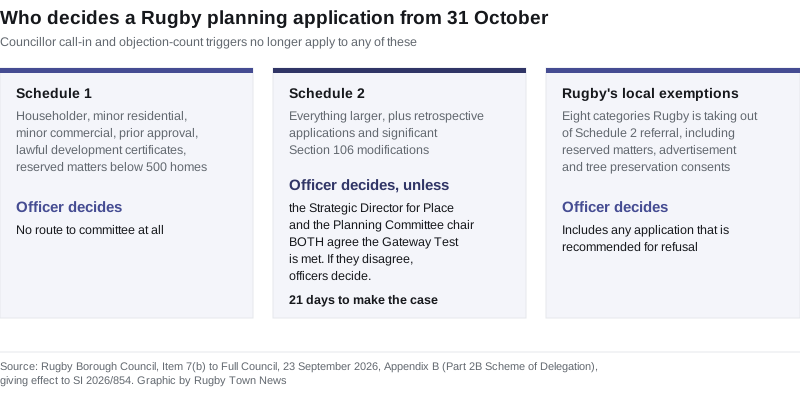
The regulations sort applications into two schedules.
Schedule 1 must be decided by an officer. There is no discretion and no route to committee at all. Rugby’s redrafted scheme lists them, and they cover most of what an ordinary resident ever applies for:
- householder applications
- minor commercial and minor residential applications
- applications for permission in principle
- certificates of lawfulness, existing or proposed
- prior approval applications
- non-material amendments to a permission
- applications made under a planning condition
- reserved matters on any outline permission below 500 dwellings or 50,000 square metres
- submission of a biodiversity gain plan
Schedule 2 goes to an officer by default. It reaches the committee only where two named people both agree that it raises “one or more issues of economic, social or environmental significance to the local area”, or “one or more significant planning matters”. That is the Gateway Test. Where the two disagree, the report is blunt: “the case MUST be determined by officers.”
And the sentence that ends the old system sits in the same appendix: “Third party representation or a Councillor call-in no longer apply to either Schedule 1 or Schedule 2 applications or own interest applications.”
The two people
Rugby’s draft names them. The nominated officer is the Chief Planning Officer, and the draft adds “for the avoidance of doubt, the Chief Planning Officer is the Strategic Director for Place”. The nominated member is the Chair of the Planning Committee, currently Councillor Sandison.
Substitutes are named too: the Vice Chair of the committee for the member, and the Development and Enforcement Manager, the Major Projects and Regeneration Manager or any Principal Planning Officer for the officer.
A referral any ward councillor could once trigger on their own now needs those two to agree with each other.
Rugby is going further than the regulations require
The regulations left two things to each council. Rugby’s report deals with both.
The first is committee size, capped nationally at 13. Rugby’s Planning Committee has 12 members and the recommendation is to leave it there, so nothing changes.
The second matters more. Councils may specify which categories of Schedule 2 application go through gateway consideration at all, and everything else simply gets decided by officers. Rugby’s recommended scheme exempts eight categories from referral, so they can never reach the committee:
- reserved matters applications
- removal of conditions
- listed building consent, unless it is for total demolition
- variation, discharge or removal of a condition of listed building consent
- any planning application connected with those two
- advertisement consent
- consent for work under a tree preservation order
- any application that is recommended for refusal
That last one is the one to notice. If officers intend to refuse, the committee cannot be asked to look at it. Separately, all applications to discharge a Section 106 obligation go to officers, and a modification reaches committee only “in exceptional circumstances” where the change is significant and material and the officer recommendation is approval.
What the last committee agenda actually shows
The Planning Committee meets at 5.30pm on Wednesday 30 September, the last full meeting before the rules change. Its agenda carries four applications, and every one of them is there for the same reason: a council officer is the applicant or the agent.
- R25/0855, a retrospective workers’ mobile home at a kennels at Stretton-on-Dunsmore, reported “as the agent for the development is an employee of the Council”
- R26/0414, ground mounted solar panels on paddock land at Leamington Hastings
- R26/0645, a carport conversion with roof solar panels at Dunchurch
- R26/0653, a single storey rear extension in Rugby
The last three each say the same line: the application “was submitted by a current officer at the Council”. Not one of the four is on the agenda because a ward councillor called it in, and not one is there because residents objected in numbers.
There is no committee meeting in October. The next one is on 4 November, four days into the new regime, and it will be the first Rugby agenda assembled under the Gateway Test.
That cuts against the usual argument on both sides. In Rugby, the routes being abolished were not the ones filling the agenda. What was filling it was the council’s own staff, and two of those four are householder applications, which from 31 October an officer must decide unless the applicant is a Service Manager or above.
What it means for you
You can still object to a planning application, and objections still have to be considered by whoever decides it. What you lose is the ability to convert objections into a public hearing.
If you want a Schedule 2 application looked at for referral, there is now a deadline. The redrafted scheme says representations must reach the case officer within 21 days of the date of notification, and must set out the reasons using the Gateway Test rather than simply objecting.
Read the two appendices side by side and they do not say the same thing about who may write. Part 2B, the scheme of delegation, says the two decision makers shall have regard to “any representations made in writing or by email”. Part 4B, the planning code, says “any representations made in writing by a Ward Councillor”. One version is open to anybody; the other is not. Both are attached to tonight’s report.
There is one piece of accountability built in. The recommendation requires “a record of the cases considered, the outcome and the reasons” to be kept and reported to the Planning Committee. That record does not exist yet. We will ask for the first one.
Two further points worth knowing. The conforming changes do not depend on tonight’s vote: the Monitoring Officer makes them under his own authority, and they take effect on 31 October either way. And if Full Council decides nothing, the committee stays at 12 and every Schedule 2 application goes through the gateway by default, which is a wider net than the scheme being recommended.
Our running coverage of applications and decisions is on the Rugby planning news page. Tonight’s other headline item, a petition for a GP surgery at Houlton, is here.
Sources: Item 7(b), Amendments to the Constitution to Give Effect to the National Scheme of Delegation for Planning, Rugby Borough Council, 23 September 2026; Public agenda, Rugby Borough Council, 23 September 2026; Agenda, Planning Committee, 30 September 2026; The Town and Country Planning (Discharge of Local Planning Authority Functions) (England) Regulations 2026; Planning Committees and the National Scheme of Delegation of Planning Functions, MHCLG, 1 June 2026.
Have your say